Complete the Matching Questions Module 2 Review Answer Key Ap Psychology
Module 12: Allure
Module Overview
Information technology was important to terminate the volume on a positive note. So much of what is researched in social psychology has a negative connotation to it such as social influence, persuasion, prejudice, and assailment. Hence, we left attraction to the finish. We first by discussing the demand for affiliation and how it develops over time in terms of smile, play, and attachment. We will hash out loneliness and how information technology affects wellness and the related concept of social rejection. We will and so discuss viii factors on attraction to include proximity, familiarity, beauty, similarity, reciprocity, playing hard to go, and intimacy. The third section will cover types of relationships and love. Finally, relationship issues are a part of life and and so we could not avoid a discussion of the four horsemen of the apocalypse. No worries. We finish the module, and book, with coverage of the beneficial effects of forgiveness.
Module Outline
- 12.i. The Need for Amalgamation
- 12.2. Factors on Allure
- 12.iii. Types of Relationships
- 12.four. Predicting the End of a Relationship
Module Learning Outcomes
- Describe the need for affiliation and the negative effects of social rejection and loneliness.
- Clarify factors that increase interpersonal attraction between 2 people.
- Place types of relationships and the components of dearest.
- Describe the Iv Horsemen of the Apocalypse equally they relate to relationship conflicts, how to resolve them, and the importance of forgiveness.
12.1. The Demand for Affiliation
Section Learning Objectives
- Define interpersonal attraction.
- Define the demand for affiliation.
- Report what the literature says well-nigh the need for affiliation.
- Define loneliness and identity its types.
- Describe smiling and how it relates to affiliation.
- Depict play and how it relates to affiliation.
- Define attachment.
- Listing and describe the four types of attachment.
- Analyze how attachment to parent leads to an attachment to God.
- Depict the effect of loneliness on health.
- Describe social rejection and its relation to affiliation.
12.1.1. Defining Cardinal Terms
Have you ever wondered why people are motivated to spend time with some people over others, or why they chose the friends and significant others they do? If yous have, you have given thought to interpersonal attraction or showing a preference for another person (remember, inter means between and so interpersonal is between people).
This relates to the need to affiliate/vest which is our motive to plant, maintain, or restore social relationships with others, whether individually or through groups (McClelland & Koestner, 1992). It is important to betoken out that we affiliate with people who have us though are generally indifferent while nosotros tend to belong to individuals who truly care about us and for whom we take an attachment. In terms of the former, you affiliate with your classmates and people you work with while yous belong to your family unit or a committed relationship with your meaning other or best friend. The literature shows that:
- Leaders high in the need for amalgamation are more than concerned about the needs of their followers and engaged in more than transformational leadership due to affiliation moderating the interplay of achievement and power needs (Steinmann, Otting, & Maier, 2016).
- Who wants to take online courses? Seiver and Troja (2014) establish that those high in the need for affiliation were less, and that those high in the need for autonomy were more, likely to desire to take another online class. Their sample included college students enrolled in classroom courses who had taken at least ane online class in the past.
- Though our need for affiliation is universal, it does not occur in every state of affairs and individual differences and characteristics of the target can factor in. Ane such difference is religiosity and van Cappellen et al. (2017) found that religiosity was positively related to social amalgamation except when the identity of the amalgamation target was manipulated to be a threatening out-group member (an atheist). In this case, religiosity did not predict affiliation behaviors.
- Hazard of exclusion from a group (not being affiliated) led individuals high in a need for inclusion/affiliation to appoint in pro-group, only not pro-self, unethical behaviors (Thau et al., 2015).
- When affiliation goals are of central importance to a person, they perceive the estimated interpersonal distance between them and other people as smaller compared to participants primed with control words (Stel & van Koningsbruggen, 2015).
Loneliness occurs when our interpersonal relationships are not fulfilling and can pb to psychological discomfort. In reality, our relationships may be fine and so our perception of being alone is what matters about and tin be peculiarly troublesome for the elderly. Tiwari (2013) points out that loneliness tin can accept three forms. First, situational loneliness occurs when unpleasant experiences, interpersonal conflicts, disaster, or accidents atomic number 82 to loneliness. Second, developmental loneliness occurs when a person cannot balance the need to relate to others with a demand for individualism, which "results in loss of significant from their life which in turn leads to emptiness and loneliness in that person." Third, internal loneliness arises when a person has low self-esteem and low self-worth and can be acquired past locus of control, guilt or worthlessness, and inadequate coping strategies. Tiwari writes, "Loneliness has at present get an of import public wellness concern. It leads to hurting, injury/loss, grief, fright, fatigue, and exhaustion. Thus, information technology besides makes a person ill and interferes in day to day performance and hampers recovery…. Loneliness with its epidemiology, phenomenology, etiology, diagnostic criteria, adverse effects, and direction should be considered a disease and should notice its place in classification of psychiatric disorders."
What do you think? Is loneliness a affliction, needing to exist listed in the DSM?
12.1.2. Development of Affiliation and Attachment
12.one.2.1. Grinning and amalgamation. Every bit early on as six-9 weeks afterwards birth, children smile reliably at things that please them. These first smiles are indiscriminate, grinning at almost anything they observe amusing. This may include a favorite toy, mobile over their crib, or even some other person. Smiles directed at other people are called social smiles. Like smiles directed at inanimate objects, they too are indiscriminate at offset but as the infant gets older, come to be reserved for specific people. These smiles fade away if the adult is unresponsive. Grinning is also used to communicate positive emotion and children get sensitive to the emotional expressions of others.
This indiscriminateness of their smiling ties in with how they perceive strangers. Before half-dozen months of age, they are not upset about the presence of people they do non know. Equally they learn to conceptualize and predict events, strangers cause anxiety and fear. This is called stranger anxiety. Non all infants reply to strangers in the same way though. Infants with more experience prove lower levels of feet than infants with little experience. Too, infants are less concerned about strangers who are female and those who are children. The latter probably has something to do with size as adults may seem imposing to children.
Important to stranger anxiety is the fact that children begin to figure people out or learn to detect emotion in others. They come up to discern vocal expressions of emotion before visual ones, mostly due to their limited visual abilities early on. As vision improves and they get improve at figuring people out, social referencing emerges effectually eight-9 months. When a child is faced with an uncertain circumstance or outcome, such as the presence of a stranger, they volition intentionally search for information well-nigh how to human action from a caregiver. So, if a stranger enters the room, an infant volition look to its mother to run into what her emotional reaction is. If the mother is happy or neutral, the infant volition non go anxious. However, if the female parent becomes distressed, the infant will respond in kind. Outside of dealing with strangers, infants will besides social reference a parent if they are given an unusual toy to play with. If the parent is pleased with the toy, the child volition play with it longer than if the parent is displeased or disgusted.
12.one.2.two. Play and affiliation. Children are besides motivated to engage in play. Upwardly to almost ane.5 years of historic period, children play alone called solitary play. Betwixt 1 ½ and 2 years of age, children play side-by-side, doing the same affair or similar things, but not interacting with each other. This is chosen parallel play. Associative play occurs next and is when two or more children interact with ane another by sharing or borrowing toys or materials. They do not do the same thing though. Around iii years of age, children appoint in cooperative play which includes games that involve grouping imagination such as "playing house." Finally, onlooker play is an important way for children to participate in games or activities they are non already engaged in. They simply wait for the right moment to bound in and then practice and then. Though play develops across time, or becomes more complex, lonely play and onlooker play practise remain options children reserve for themselves. Sometimes we just want to play a game by ourselves and non have a friend split the screen with us, as in the case of video games and if they are on the couch next to you.
12.one.2.three. Zipper and affiliation, to people and God. Zipper is an emotional bond established betwixt two individuals and involving one's sense of security. Our attachments during infancy have repercussions on how we chronicle to others the rest of our lives. Ainsworth et al. (1978) identified three attachment styles an infant possesses. The commencement is a secure attachment and results in the apply of a mother every bit a home base to explore the world. The child will occasionally return to her. She also becomes upset when she leaves and goes to the mother when she returns. Side by side is the avoidantly attached kid who does not seek closeness with her and avoids the mother after she returns. Finally, is the ambivalent attachment in which the kid displays a mixture of positive and negative emotions toward the female parent. She remains relatively shut to her which limits how much she explores the globe. If the mother leaves, the child volition seek closeness with the mother all the while boot and hit her.
A fourth style has been added due to recent research. This is the disorganized-disoriented attachment style which is characterized by inconsistent, often contradictory behaviors, confusion, and mazed behavior (Chief & Solomon, 1990). An case might exist the child approaching the mother when she returns, simply not making eye contact with her.
The interplay of a caregiver'southward parenting style and the child'southward subsequent attachment to this parent has long been considered a factor on the psychological health of the person throughout life. For example, male parent'south psychological autonomy has been shown to atomic number 82 to greater academic performance and fewer signs of depression in quaternary graders (Mattanah, 2001). Attachment is also of import when the child is leaving home for the showtime time to become to college. Mattanah, Hancock, and Brand (2004) showed in a sample of 4 hundred 4 students at a university in the Northeastern United States that separation individuation mediated the link betwixt secure zipper and college aligning. The nature of developed romantic relationships has been associated with attachment style in infancy (Kirkpatrick, 1997). One final manner this appears in adulthood is through a person'southward relationship with a god figure.
An extrapolation of zipper inquiry is that we can perceive God'south dearest for the individual in terms of a mother's dearest for her child, merely this attachment is not always to God. For case, Protestants, seeing God as afar, apply Jesus to class an attachment relationship while Catholics utilize Mary as their ideal attachment figure. It could be that negative emotions and insecurity in relation to God practise not always signify the lack of an zipper human relationship, simply maybe a different type of pattern or style (Kirkpatrick, 1995). Consider that an driveling child notwithstanding develops an attachment to an calumniating mother or male parent. The same could occur with God and may well explain why images of vindictive and frightening gods take survived through human history.
One of import matter to notation is that in human relationships, the other person's deportment can affect the relationship, for better or worse. Perceived relationships with God exercise not take this quality. As God cannot affect us, we cannot affect Him. This allows the person to invent or reinvent the relationship with God in secure terms without allowing counterproductive behaviors to retard progress. Hence, Kirkpatrick (1995) says people "with insecure attachment histories might exist able to find in God…the kind of secure attachment relationship they never had in human interpersonal relationships (p. 62)." The best man zipper figures are ultimately fallible while God is not limited by this.
Pargament (1997) defined three styles of attachment to God. First is the 'secure' attachment in which God is viewed as warm, receptive, supportive, and protective, and the person is very satisfied with the relationship. Next is the 'avoidant attachment' in which God is seen as impersonal, distant, and disinterested, and the person characterizes the human relationship as one in which God does not care well-nigh him or her. Finally, is the 'anxious/ambivalent' attachment. Here, God seems to be inconsistent in His reaction to the person, sometimes warm and receptive and sometimes not. The person is not sure if God loves him or non. Nosotros might say that the God of the secure attachment is the authoritative parent, the God of the avoidant attachment is authoritarian, and the God of the anxious/clashing zipper is permissive.
Kirkpatrick and Shaver (1990) annotation that attachment and organized religion may be linked in important ways. They offering a "compensation hypothesis" which states that insecurely attached individuals are motivated to compensate for the absenteeism of this secure relationship by believing in a loving God. Their study evaluated the self-reports of 213 respondents (180 females and 33 males) and plant that the avoidant parent-child zipper relationship yielded greater levels of developed religiousness while those with secure attachment had lower scores. The avoidant respondents were also four times as likely to accept experienced a sudden religious conversion.
They besides remind the reader that the child uses the zipper effigy every bit a oasis and secure base of operations, and go on to annotation that there is ample evidence to suggest the aforementioned function for God. Bereaved persons become more religious, soldiers pray in foxholes, and many who are in emotional distress plow to God. Further, Christianity has a plethora of references to God being past 1's side always and the person having a friend in Jesus.
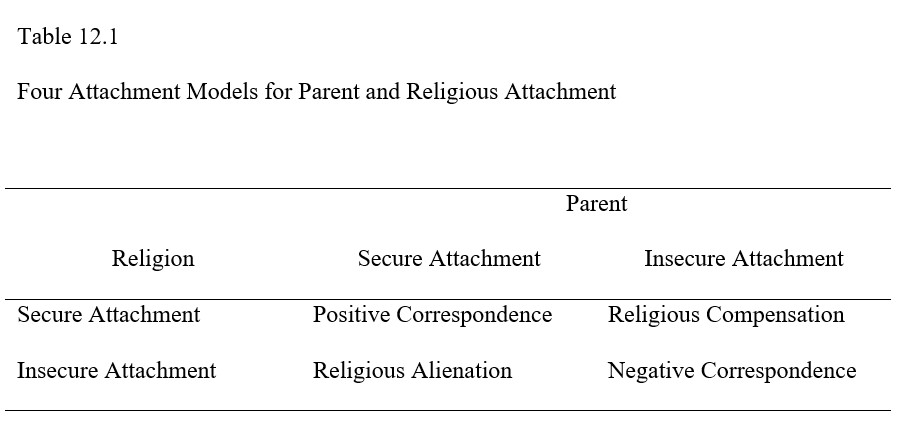
Pargament (1997) expanded upon the bounty hypothesis and showed that the relationship between attachment history and religious behavior is far from unproblematic. He summarized 4 relationships between parental and religious attachments extrapolated from Kirkpatrick'south research. Offset, if a child had a secure attachment to the parent, he may develop a secure attachment to religion, called 'positive correspondence.' In this scenario, the result of a loving and trusting human relationship with ane's parents is transferred to God too. This is contrary to the findings of Kirkpatrick and Shaver (1990) which said that securely attached individuals displayed lower levels of religiosity. More in line with their view is Pargament's second category, secure zipper to parents and insecure attachment to religion, chosen 'religious alienation.' Here the person who had a secure attachment to parents may not feel the need to believe in God. He does non need to recoup for whatsoever deficiencies.
The tertiary category is too in line with Kirkpatrick and Shaver'south report. Modeled after their hypothesis, 'religious compensation' results from an insecure zipper to parents and a secure zipper to religion. Finally, an insecure zipper to parents may yield an insecure zipper to religion called 'negative correspondence' (meet Tabular array 12.i). These insecure parental ties have left the person unequipped to build neither strong developed attachments nor a secure spiritual human relationship. The person may cling to "false gods" like drug and alcohol addiction, food addiction, religious dogmatism, a religious cult, or a codependent relationship.
12.one.iii. Health Factors
"Loneliness kills." These were the opening words of a March eighteen, 2015 Time article describing alarming research which shows that loneliness increases the gamble of death. How and so? According to the meta-analysis of 70 studies published from 1980 to 2014, social isolation increases mortality past 29%, loneliness does and so by 26%, and living alone by 32%; but existence socially continued leads to higher survival rates (Holt-Lunstad et al., 2015). The authors note, equally did Tiwari (2013) earlier, that social isolation and loneliness should be listed as a public wellness concern every bit it tin pb to poorer wellness and decreased longevity, too as CVD (coronary vascular affliction; Holt-Lunstad & Smith, 2016). Other ill effects of loneliness include greater stimulated cytokine production due to stress which in turn causes inflammation (Jaremka et al., 2013); greater occurrence of suicidal behavior (Stickley & Koyanagi, 2016); hurting, depression, and fatigue (Jarema et al., 2014); and psychotic disorders such equally delusional disorders, depressive psychosis, and subjective thought disorder (Badcock et al., 2015).
On a positive notation, Stanley, Conwell, Bowen, and Van Orden (2013) establish that for older adults who study feeling solitary, owning a pet is one way to feel socially connected. In their written report, pet owners were found to be 36% less likely than non-pet owners to written report feeling solitary. Those who lived alone and did not ain a pet had the greatest odds of reporting loneliness. But the authors offer an admonition – owning a pet, if not managed properly, could actually be deleterious to health. They write, "For instance, an older adult may place the well-being of their pet over the safety and wellness of themselves; they may pay for meals and veterinary services for their pet at the expense of their own meals or healthcare." Bereavement concerns were also raised, though they say that with careful planning, any negative consequences of owning a pet can exist mitigated.
To read the Time article, please visit: http://time.com/3747784/loneliness-mortality/
12.1.4. Social Rejection
Being rejected or ignored by others, called ostracism, hurts. No literally. It hurts. Research by Kross, Berman, Mischel, Smith, and Wager (2011) has shown that when rejected, brain areas such every bit the secondary somatosensory cortex and dorsal posterior insula which are implicated in the experience of physical hurting, become active. And then non only are the experiences of physical pain and social rejection lamentable, the authors say that they share a mutual somatosensory representation as well.
Then, what practise you practice if you have experienced social rejection? A 2012 article past the American Psychological Association says to seek inclusion elsewhere. Those who have been excluded tend to get more than sensitive to opportunities to connect and adjust their beliefs as such. They may act more than likable, show greater conformity, and comply with the requests of others. Of grade, some reply with anger and assailment instead. The commodity says, "If someone'south primary business concern is to reassert a sense of control, he or she may get aggressive as a mode to force others to pay attention. Sadly, that tin create a downwards spiral. When people act aggressively, they're fifty-fifty less likely to gain social acceptance." The furnishings of long-term ostracism can exist devastating but non-chronic rejection tin can be easier to convalesce. Seek out healthy positive connections with both friends and family as a way to combat rejection.
For more on the APA commodity, come across https://www.apa.org/monitor/2012/04/rejection.
12.ii. Factors on Attraction
Section Learning Objectives
- Clarify how proximity affects interpersonal attractiveness.
- Clarify how familiarity affects interpersonal attractiveness.
- Analyze how dazzler affects interpersonal bewitchery.
- Clarify how similarity affects interpersonal attractiveness.
- Clarify how reciprocity affects interpersonal attractiveness.
- Clarify how playing hard to get affects interpersonal bewitchery.
- Clarify how intimacy affects interpersonal attractiveness.
- Describe mate pick strategies used by men and women.
On April 7, 2015, Psychology Today published an commodity entitled, The Iv Types of Attraction. Referred to as an attraction pyramid, information technology places status and health at the lesser, emotional in the centre, and logic at the elevation of the pyramid. Status takes on two forms. Internal refers to confidence, your skills, and what you believe or your values. External refers to your job, visual markers, and what y'all own such equally a squeamish car or house. The article states that confidence may be particularly of import and overrides external status in the long run. Health tin can include the mode you lot await, movement, aroma, and your intelligence. The centre level is emotional which includes what makes us unique, trust and condolement, our emotional intelligence, and how mysterious nosotros appear to a potential suitor. And and so at the meridian is logic which helps united states to exist sure this individual is aligned with us in terms of life goals such as having kids, getting married, where nosotros will live, etc. The article says – "With greater alignment, there is greater attraction." Since online romance is trending at present, the pyramid flips and we focus on logic, then emotion, and and then status and health, but meeting in person is of import and should exist done every bit soon every bit possible. This manner, we can be sure at that place is a physical attraction and can simply exist validated in person.
To read the article for yourself, visit: https://www.psychologytoday.com/us/blog/valley-girl-brain/201504/the-four-types-attraction
So how accurate is the commodity? We will tackle several factors on attraction to include proximity, familiarity, concrete bewitchery, similarity, reciprocity, the hard-to-get effect, and intimacy, then close with a word of mate choice.
12.2.i. Proximity
First, proximity states that the closer two people alive to one another, the more probable they are to interact. The more than frequent their interaction, the more likely they will like one another so. Is it possible that individuals living in a housing development would strike up friendships while doing chores? This is exactly what Festinger, Schachter, and Back (1950) found in an investigation of 260 married veterans living in a housing project at MIT. Proximity was the primary factor that led to the formation of friendships. For proximity to work, people must be able to appoint in face up-to-confront communication, which is possible when they share a communication infinite and fourth dimension (Monge & Kirste, 1980) and proximity is a determinant of interpersonal attraction for both sexes (Allgeier and Byrne, 1972). A more than recent study of xl couples from Punjab, Pakistan provides cross-cultural show of the importance of proximity also. The authors write, "The results of qualitative analysis showed that friends who stated that they share the same room or same town were shown to have higher scores on interpersonal attraction than friends who lived in distant towns and cities" (pg. 145; Batool & Malik, 2010).
12.2.two. Mere Exposure – A Case for Familiarity?
In fact, the more we are exposed to novel stimuli, the greater our liking of them volition exist, called the mere exposure effect. Across 2 studies, Saegert, Swap, & Zajonc (1973) found that the more often we are exposed to a stimulus, even if it is negative, the greater our liking of it will be, and that this holds true for inanimate objects but also interpersonal attitudes. They conclude, "…the mere repeated exposure of people is a sufficient condition for enhancement of attraction, despite differences in favorability of context, and in the absenteeism of any obvious rewards or punishments past these people" (pg. 241).
Peskin and Newell (2004) present an interesting study investigating how familiarity affects attraction. In their first experiment, participants rated the attractiveness, distinctiveness, and familiarity of 84 monochrome photographs of unfamiliar female faces obtained from US high school yearbooks. The ratings were made past three different groups – 31 participants for the attractiveness rating, 37 for the distinctiveness rating, and 30 for the familiarity rating – and no participant participated in more than than ane of the studies. In all three rating studies, a vii-point scale was used whereby 1 indicated that the face was not attractive, distinctive, or familiar and seven indicated that it was very attractive, distinctive, or familiar. They establish a pregnant negative correlation between bewitchery and distinctiveness and a pregnant positive correlation between attractiveness and familiarity scores, consistent with the literature.
In the second experiment, 32 participants were exposed to 16 of the 24 about typical and xvi of the 24 near distinctive faces from the experiment and the other 8 faces serving every bit controls. The controls were shown once during the judgment stage while the sixteen typical and sixteen distinctive faces were shown six times for a full of 192 trials. Ratings of bewitchery were given during the judgment stage. Results showed that repeated exposure increased attractiveness ratings overall, and at that place was no divergence between typical and distinctive faces. These results were plant to exist due to increased exposure and not judgment bias or experimental atmospheric condition since the attractiveness ratings of the 16 command faces were compared to the same faces from experiment i and no significant difference between the two groups was found.
Overall, Peskin and Newell (2004) state that their findings prove that increasing the familiarity of faces past increasing exposure led to increased attractiveness ratings. They add together, "We besides demonstrated that typical faces were found to be more than attractive than distinctive faces although both face types were subjected to similar increases in familiarity" (pg. 156).
12.2.three. Physical Bewitchery
2d, we choose who nosotros spend time with based on how attractive they are. Attractive people are seen every bit more interesting, happier, smarter, sensitive, and moral and every bit such are liked more than than less attractive people. This is partly due to the halo effect or when nosotros agree a favorable attitude to traits that are unrelated. We see beauty as a valuable asset and ane that can be exchanged for other things during our social interactions. Between personality, social skills, intelligence, and attractiveness, which characteristic do yous think matters near in dating? In a field study randomly pairing subjects at a "Estimator Trip the light fantastic" the largest determinant of how much a partner was liked, how much he wanted to engagement the partner over again, and how frequently he asked the partner out, was just the physical attractiveness of the partner (Walster et al., 1966).
In a more contemporary twist on dating and interpersonal attraction, Luo and Zhang (2009) looked at speed dating. Results showed that the biggest predictor of attraction for both males and females was the physical attractiveness of their partner (reciprocity showed some influence though similarity produced no evidence – both will exist discussed shortly and then keep information technology in mind for now).
Is beauty linked to a name though? Garwood et al. (1980) asked 197 higher students to choose a beauty queen from half dozen photographs, all equivalent in terms of physical attractiveness. Half of the women in the photographs had a desirable kickoff name while the other one-half did not. Results showed that girls with a desirable outset name received 158 votes while those with an undesirable first name received just 39 votes.
Then why beauty? Humans brandish what is called a dazzler bias. Struckman-Johnson and Struckman- Johnson (1994) investigated the reaction of 277 male, heart-grade, Caucasian college students to a vignette in which they were asked to imagine receiving an uninvited sexual advance from a casual female acquaintance. The vignette displayed different degrees of coercion such as depression-touch, moderate-push, high-threat, and very high-weapon. The results showed that men had a more positive reaction to the sexual advance of a female person associate who was attractive and who used low or moderate levels of coercion than to an unattractive female person.
What about attractiveness in the workplace? Hosoda, Stone-Romero, and Coats (2006) establish considerable support for the notion that attractive individuals fare meliorate in employment-related decisions (i.e., hiring and promotions) than unattractive individuals. Although there is a beauty bias, the authors found that its strength has weakened over the past few decades.
12.ii.4. Similarity
You have probable heard the expressions "Opposites attract" and "Birds of a plume flock together." The quondam expression contradicts the latter, and and then this leads u.s.a. to wonder which is it? Inquiry shows that we are most attracted to people who are like u.s. in terms of our religious and political beliefs, values, appearance, educational background, age, and other demographic variables (Warren, 1966). Thus, we tend to choose people who are similar to us in attitudes and interests as this leads to a more than positive evaluation of them. Their agreement with our choices and beliefs helps to reduce any doubtfulness nosotros face regarding social situations and improves our agreement of the situation. Y'all might say their similarity also validates our ain values, beliefs, and attitudes as they have arrived at the same conclusions that we have. This occurs with identification with sports teams. Our perceived similarity with the group leads to grouping-derived self-definition more then than the attractiveness of the grouping such that, "… a team that is "rough, rude, and unattractive" may be highly-seasoned to fans who have the same qualities, simply repulsive to fans who are more than "civilized"." The authors suggest that sports marketers could emphasize the similarities betwixt fans and their teams (Fisher, 1998). Another course of similarity is in terms of concrete bewitchery. According to the matching hypothesis, we date others who are like to us in terms of how attractive they are (Feingold, 1988; Huston, 1973; Bersheid et al., 1971; Walster, 1970).
12.2.5. Reciprocity
Fourth, we cull people who are likely to engage in a mutual exchange with usa. Nosotros prefer people who make us feel rewarded and appreciated and in the spirit of reciprocation, we need to give something dorsum to them. This substitution continues so long equally both parties regard their interactions to be mutually benign or the benefits of the exchange outweigh the costs (Homans, 1961; Thibaut & Kelley, 1959). If yous were told that a stranger you interacted with liked y'all, enquiry shows that yous would limited a greater liking for that person as well (Aronson & Worchel, 1966) and the same goes for reciprocal desire (Greitmeyer, 2010).
12.2.half dozen. Playing Hard to Go
Does playing hard to go make a woman (or man) more than desirable than the ane who seems eager for an brotherhood? Results of v experiments said that it does non though a sixth experiment suggests that if the woman is easy for a particular man to become just hard for all other men to get, she would exist preferred over a woman who is uniformly hard or like shooting fish in a barrel to get, or is a adult female for which the human has no information virtually. Men gave these selective women all of the avails (i.due east. selective, pop, friendly, warm, and like shooting fish in a barrel going) merely none of the liabilities (i.e. problems expected in dating) of the uniformly difficult to get and easy to go women. The authors state, "Information technology appears that a woman can intensify her desirability if she acquires a reputation for beingness hard-to-go and so, by her beliefs, makes information technology clear to a selected romantic partner that she is attracted to him" (pg. 120; Walster et al., 1973). Dai, Dong, and Jia (2014) predicted and found that when person B plays difficult to get with person A, this will increase A'southward wanting of B but simultaneously decrease A's liking of B, only if A is psychologically committed to pursuing further relations with B. Otherwise, the difficult to get strategy will result in decreased wanting and liking.
12.2.7. Intimacy
Finally, intimacy occurs when we feel close to and trust in some other person. This factor is based on the idea of cocky-disclosure or telling some other person about our deepest held secrets, experiences, and beliefs that we practise non usually share with others. But this revealing of information comes with the expectation of a common cocky-disclosure from our friend or significant other. We might recollect that self-disclosure is difficult online but a study of 243 Facebook users shows that we tell our personal secrets on Facebook to those we like and that we experience we tin can disclose such personal details to people with whom we talk oftentimes and come to trust (Sheldon, 2009).
This said, there is a possibility we can overshare, called overdisclosure, which may pb to a reduction in our attractiveness. What if you showed up for form a few minutes early on and sat next to 1 of your classmates who proceeded to requite you every item of their weekend of illicit drug use and sexual activity? This would likely make you lot feel uncomfortable and seek to move to another seat.
12.2.8. Mate Selection
As you lot volition see in a bit, men and women have vastly dissimilar strategies when information technology comes to selecting a mate. This leads united states of america to inquire why, and the respond is rooted in evolutionary psychology. Mate pick occurs universally in all homo cultures. In a trend seen around the world, Kiss (2004) said that since men tin father a nearly unlimited number of children, they favor signs of fertility in women to include being young, attractive, and healthy. Since they also desire to know that the kid is their own, they favor women who will be sexually faithful to them.
In contrast, women favor a more selective strategy given the incredible time investment having a child involves and the fact that she tin only take a limited number of children during her life. She looks for a man who is financially stable and can provide for her children, typically being an older man. In support of the divergence in age of a sexual partner pursued by men and women, Buss (1989) found that men wanted to marry women 2.7 years younger while women preferred men 3.four years older. Also, this finding emerged cross-culturally.
12.iii. Types of Relationships
Department Learning Objectives
- Describe how the social exchange theory explains relationships.
- Depict how the disinterestedness theory explains relationships.
- List and describe types of relationships.
- Define beloved and describe its three components according to Sternberg.
- Define jealousy.
12.3.1. Social Commutation Theory
Recall from Department 11.2.nine that social exchange theory is the idea that we utilize a minimax strategy whereby we seek to maximize our rewards all while minimizing our costs. In terms of relationships, those that take less costs and more rewards will be favored, concluding longer, and be more fulfilling. Rewards include having someone to panel united states during difficult times, companionship, the experience of love, and having a committed sexual partner for romantic relationships. Costs include the experience of disharmonize, having to compromise, and needing to sacrifice for another.
12.iii.2. Equity Theory
Disinterestedness theory (Walster et al., 1978) consists of four propositions. First, it states that individuals will endeavour to maximize outcomes such that rewards win out over punishments. 2nd, groups will evolve systems for deservedly apportioning rewards and punishments among members and members will exist expected to adhere to these systems. Those who are equitable to others will be rewarded while those who are not will be punished. Tertiary, individuals in inequitable relationships will experience distress proportional to the inequity. Fourth, those in inequitable relationships will seek to eliminate their distress by restoring disinterestedness and will work harder to achieve this the greater the distress they experience. The goal is for all participants to experience they are receiving equal relative gains from the relationship.
According to Hatfield and Traupmann (1981) if an individual feels that the ratio betwixt benefits and costs are disproportionately in favor of the other partner, he or she may feel ripped off or underbenefited, and experience distress. And then, what can be done about this? The authors state, "There are simply two ways that people can set things right: they can re-establish bodily equity or psychological equity. In the first case they can inaugurate real changes in their relationships, e.g. the underbenefited may well ask for more out of their relationships, or their overbenefited partners may offer to try to give more. In the latter case couples may notice it harder to alter their behavior than to change their minds and so prefer to close their optics and to reassure themselves that "really, everything is in perfect order"" (pg.168).
12.3.3. Types of Relationships
Relationships can take on a few different forms. In what are called communal relationships, there is an expectation of mutual responsiveness from each member every bit information technology relates to tending to fellow member's needs while exchange relationships involve the expectation of reciprocity in a form of tit-for-tat strategy. This leads to what are called intimate or romantic relationships in which you lot feel a very potent sense of attraction to another person in terms of their personality and physical features. Dearest is often a cardinal feature of intimate relationships.
12.3.4. Love
1 issue of this allure to others, or the demand to affiliate/belong is love. What is dearest? According to a 2011 article in Psychology Today entitled 'What is Love, and What Isn't It?' dearest is a force of nature, is bigger than nosotros are, inherently free, cannot be turned on as a advantage or off every bit a penalty, cannot be bought, cannot be sold, and cares what becomes of us). Adrian Catron writes in an article entitled, "What is Honey? A Philosophy of Life" that "the word dearest is used every bit an expression of affection towards someone else….and expresses a human virtue that is based on compassion, affection and kindness." He goes on to say that dear is a practice and you tin can practice it for the rest of your life. (https://www.huffpost.com/entry/what-is-love-a-philosophy_b_5697322). And finally, the Merriam Webster dictionary online defines dear every bit "stiff affection for another arising out of kinship or personal ties" and "attraction based on sexual want: affection and tenderness felt past lovers." (Source: https://www.merriam-webster.com/dictionary/beloved).
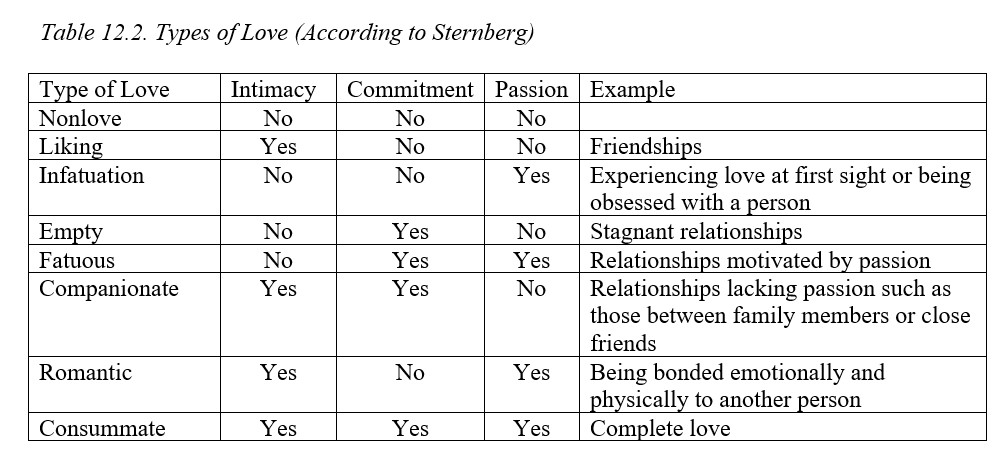
Robert Sternberg (1986) said love is composed of three main parts (called the triangular theory of dearest): intimacy, delivery, and passion. First, intimacy is the emotional component and involves how much we like, feel close to, and are connected to another person. It grows steadily at first, slows downwardly, and and then levels off. Features include holding the person in high regard, sharing personal affect with them, and giving them emotional support in times of demand. Second, commitment is the cognitive component and occurs when yous decide you truly beloved the person. Y'all decide to make a long-term commitment to them and as you might expect, is almost not-existent when a relationship begins and is the final to develop usually. If a relationship fails, delivery would show a pattern of declining over time and somewhen returns to zero. Third, passion represents the motivational component of love and is the first of the three to develop. Information technology involves allure, romance, and sexual activity and if a human relationship ends, passion can fall to negative levels every bit the person copes with the loss.
This results in 8 subtypes of love which explains differences in the types of love we express. For instance, the honey nosotros experience for our significant other will exist unlike than the love we feel for a neighbor or coworker, and reflect different aspects of the components of intimacy, commitment, and passion as follows:
12.3.4.1. Jealousy. The dark side of beloved is what is called jealousy, or a negative emotional state arising due to a perceived threat to one'southward relationship. Take annotation of the word perceived here. The threat does non have to be real for jealousy to rear its ugly head and what causes men and women to experience jealous varies. For women, a man'southward emotional infidelity leads her to fright him leaving and withdrawing his financial back up for her offspring, while sexual adultery is of greater business organisation to men equally he may worry that the children he is supporting are not his ain. Jealousy can likewise arise amongst siblings who are competing for their parent'south attention, among competitive coworkers especially if a highly desired position is needing to be filled, and among friends. From an evolutionary perspective, jealousy is essential every bit it helps to preserve social bonds and motivates activeness to keep of import relationships stable and safety. But it can also lead to assailment (Dittman, 2005) and mental health issues.
12.four. Predicting the End of a Relationship
Section Learning Objectives
- Describe Gottman'southward 4 Horsemen of the Apocalypse.
- Propose antidotes to the horsemen.
- Clarify the importance of forgiveness in relationships.
12.4.ane. Advice, Disharmonize, and Successful Resolution
John Gottman used the metaphor of the 4 Horsemen of the Apocalypse from the New Testament to draw communication styles that can predict the stop of a relationship. Though not conquest, war, hunger, and death, Gottman instead used the terms criticism, contempt, defensiveness, and stonewalling. Each volition be discussed below, as described on Gottman'due south website: https://world wide web.gottman.com/blog/the-four-horsemen-recognizing-criticism-contempt-defensiveness-and-stonewalling/
First, criticism occurs when a person attacks their partner at their core character "or dismantling their whole existence" when criticized. An example might be calling them selfish and proverb they never think of you. Information technology differs from a complaint which typically involves a specific issue. For example, one night in March 2019 my married woman was stuck at work until after 8pm. I was upset every bit she did not telephone call to let me know what was going on and nosotros take an agreement to inform ane another about changing work schedules. Criticism can become pervasive and when it does, it leads to the other, far deadlier horsemen. "Information technology makes the victim feel assaulted, rejected, and hurt, and often causes the perpetrator and victim to fall into an escalating pattern where the showtime horseman reappears with greater and greater frequency and intensity, which eventually leads to contempt."
The second horseman is antipathy which involves treating others with disrespect, mocking them, ridiculing, being sarcastic, calling names, or mimicking them. The point is to make the target feel despised and worthless. "About chiefly, contempt is the single greatest predictor of divorce. Information technology must exist eliminated."
Defensiveness is the 3rd horseman and is a response to criticism. When we feel unjustly accused, we accept a trend to make excuses and play the innocent victim to become our partner to back off. Does it work though? "Although it is perfectly understandable to defend yourself if y'all're stressed out and feeling attacked, this approach will not have the desired event. Defensiveness will simply escalate the conflict if the critical spouse does not back downwards or apologize. This is because defensiveness is really a way of blaming your partner, and it won't allow for healthy disharmonize direction."
Stonewalling is the fourth horseman and occurs when the listener withdraws from the interaction, shuts downwards, or stops responding to their partner. They may melody out, act busy, appoint in distracting behavior, or turn away and stonewalling is a response to contempt. "It is a result of feeling physiologically flooded, and when we stonewall, nosotros may non even be in a physiological country where nosotros can discuss things rationally."
Conflict is an unavoidable reality of relationships. The good news is that each horseman has an antitoxin to stop it. How so?
- To combat criticism, engage in gentle start up. Talk about your feelings using "I" statements and not "you lot" and express what yous need to in a positive way. As the website demonstrates, instead of saying "You e'er talk well-nigh yourself. Why are you ever so selfish?" say, "I'm feeling left out of our talk tonight and I need to vent. Can we please talk about my day?"
- To combat contempt, build a civilisation of appreciation and respect. Regularly express appreciation, gratitude, affection, and respect for your partner. The more than positive you are, the less likely that contempt volition be expressed. Instead of saying, "You forgot to load the dishwasher over again? Ugh. Yous are and then incredibly lazy." (Rolls eyes.) say, "I understand that you've been busy lately, only could you lot please remember to load the dishwasher when I work belatedly? I'd appreciate information technology."
- To gainsay defensiveness, take responsibility. You lot can do this for merely role of the conflict. A defensive comment might be, "It's not my mistake that nosotros're going to be late. It's your fault since you ever get dressed at the last second." Instead, say, "I don't like being late, only you're right. We don't always accept to get out so early. I can be a little more flexible."
- To combat stonewalling, engage in physiological self-soothing. Arguing increases one's heart charge per unit, releases stress hormones, and activates our flight-fight response. Past taking a short break, nosotros can calm down and "return to the word in a respectful and rational way." Declining to have a break could lead to stonewalling and bottling up emotions, or exploding like a volcano at your partner, or both. "So, when yous take a break, it should last at to the lowest degree twenty minutes because it will accept that long before your body physiologically calms down. It's crucial that during this fourth dimension you avert thoughts of righteous indignation ("I don't accept to have this anymore") and innocent victimhood ("Why is he always picking on me?"). Spend your time doing something soothing and distracting, like listening to music, reading, or exercising. It doesn't really matter what you do, every bit long as it helps y'all to calm downwardly."
12.four.2. Forgiveness
Co-ordinate to the Mayo Clinic, forgiveness involves letting go of resentment and any thought we might have most getting revenge on someone for by wrongdoing. And so what are the benefits of forgiving others? Our mental health will be better, we will experience less anxiety and stress, we may feel fewer symptoms of low, our heart will exist healthier, we volition feel less hostility, and our relationships overall will exist healthier.
It'due south easy to concord a grudge. Let'southward face information technology, whatever the cause, it likely left united states feeling aroused, confused, and distressing. We may fifty-fifty be bitter non only to the person who slighted us merely extend this to others who had goose egg to do with the situation. We might have trouble focusing on the present as nosotros dwell on the past and feel like life lacks meaning and purpose.
Merely fifty-fifty if we are the type of person who holds grudges, we can learn to forgive. The Mayo Clinic offers some useful steps to help us go there. First, we should recognize the value of forgiveness. Next, nosotros should determine what needs healing and who we should forgive and for what. Then we should consider joining a support group or talk with a counselor. Fourth, nosotros need to acknowledge our emotions, the damage they do to u.s.a., and how they affect our behavior. Nosotros and so attempt to release them. Fifth, choose to forgive the person who offended us leading to the final step of moving away from seeing ourselves as the victim and "release the control and power the offending person and situation take had in your life."
At times, we all the same cannot forgive the person. They recommend practicing empathy and so that we can see the situation from their perspective, praying, reflecting on instances of when you lot offended another person and they forgave you lot, and be aware that forgiveness does not happen all at once just is a process.
Read the article by visiting: https://world wide web.mayoclinic.org/healthy-lifestyle/adult-wellness/in-depth/forgiveness/art-20047692
Module Recap
That's it. With the close of this module, we also finish the book. Nosotros promise you lot enjoyed learning about attraction and the diverse factors on it, types of relationships, and complications we might endure. As we learned, conflict is inevitable in whatsoever type of human relationship, but there is hope. Never give up or give in.
Module 12 is the last in Part 4: How We Relate to Others.
2nd edition
Source: https://opentext.wsu.edu/social-psychology/chapter/module-12-attraction/
Belum ada Komentar untuk "Complete the Matching Questions Module 2 Review Answer Key Ap Psychology"
Posting Komentar